

Introduction
Perspective: Confronting the Inevitable
Making Contact with Reality
Grieving Past Identities
Aging Is Asymmetrical
Empirical Evidence: What the Research Shows
The Practical Advantage
Conclusion & Key Takeaways
Introduction
We should approach this subject by distinguishing between the fear of aging and the fear of irreversibility. Aging is a visible phenomenon, but for many older adults, a deeper, underlying anxiety exists: The realization that time moves in one direction, possibilities narrow, and the future contains losses that cannot be haggled away. If metathesiophobia is understood as a fear of unwanted change—change beyond our control—then aging is perhaps its most comprehensive expression because it embodies every form of undesirable, irreversible change at once: physical, social, psychological, and existential.
Perhaps the healthiest psychological confrontation is not one that aims to retard, restrain, or eliminate fear, but to change our relationship with inevitability.
Many aging adults try to restrain change by going through a midlife crisis and, in a sense, putting their existential dread on pause. But a midlife crisis, in this sense, is merely control as camouflage for grief. It’s an attempt to camouflage the feelings of dread and angst associated with aging. So how can we confront it?

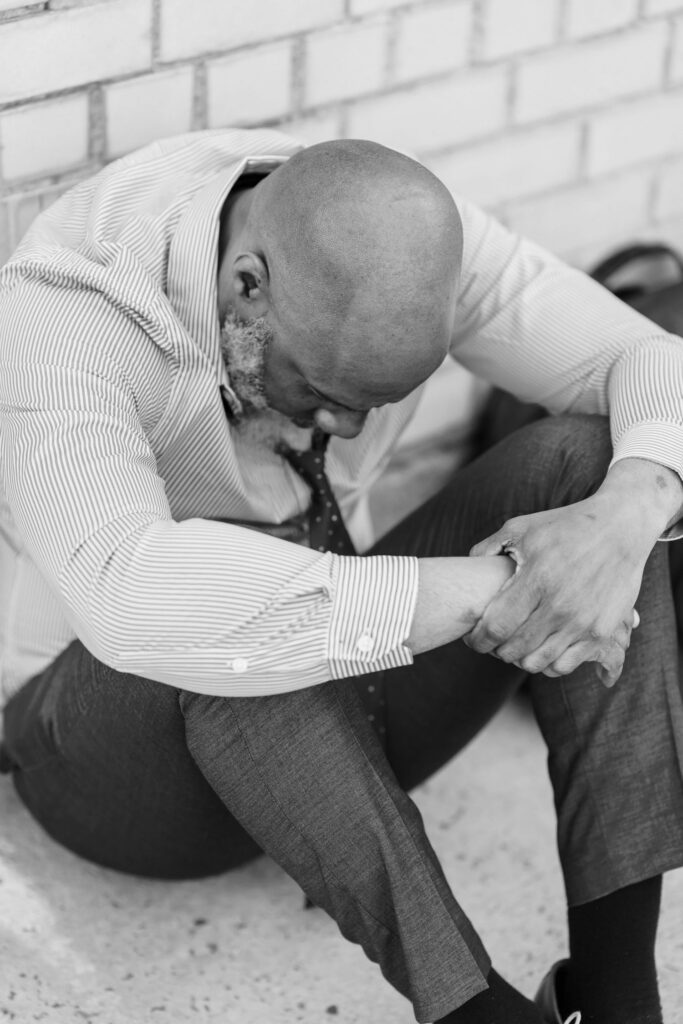
Perspective: Confronting the Inevitable
Perhaps the healthiest psychological confrontation is not one that aims to retard, restrain, or eliminate fear, but to change our relationship with inevitability. The objective is neither resignation nor optimism. Rather, it involves assuming a more accurate cognitive stance toward reality; i.e., we shift from control to stewardship.
In youth, control as a strategy is adaptive because effort frequently produces measurable, proportional results. In youth, customarily, we study, acquire skills, exercise, build new relationships, and experience tangible progress. This is a great strategy when we’re young, but not so much in adulthood. As adults, we tend to organize our lives around control, but aging gradually exposes the limits of this Weltanschauung. Our hair turns grey despite proper, mindful nutrition. Memory frequently becomes less reliable, despite intellectual engagement. Health and age catch up to friends who die, despite our devotion to them. Parents become frail and die. Even our own bodies become less forgiving; more things hurt, become weaker, and become more susceptible to injury.
This is why psychological health insists that we replace the paradigm of control with one of stewardship. This helps to preserve agency without the demand of omnipotence. Existential dread often becomes pathological because we misinterpret it as evidence that something is wrong. But what if dread is experienced as an adaptive signal? What if dread informs us about the finitude of time, changes in identity, and the need to reprioritize certain aspects of our lives? Existential dread, at the end of the day, is data, not an emergency.
Making Contact with Reality
Our emotions need not dictate our behaviors. This parallels cognitive approaches to anxiety in general, wherein thoughts and feelings are treated as data and not as commands. Instead of having a midlife crisis because “I’m terrified of getting older,” it becomes “I’m getting older, but I’m not obligated to organize my life around denying my mortality.” And this distinction, albeit subtle, dramatically reduces our compulsion to preserve youth; i.e., no need to go out and get that ‘Vette, motorcycle, breast augmentation, lip fillers, and the like.
There’s some guy out there today who thinks he’s just going to go out, get a new sports car, drive off in a more youthful direction, leaving the past and everything in it behind. Here’s the harsh truth about the past: It isn’t a place you can drive away from and leave behind. It’s the road itself—always beneath you, always carrying you forward to the same inevitable destination—the past. And try as you may, when you project yourself into the past, you cannot escape the feeling of guilt. Maybe it’s abandoning your family, maybe it’s friends, maybe it’s the responsibilities that have accumulated with time; it really doesn’t matter. Because that guilt, like the past, is always present; there’s no escape.
Grieving Past Identities
Moreover, the time that passes belongs to death, so there’s no need to grieve the self that no longer exists (I know how tough that can be). But here’s the thing about aging healthfully: It involves acknowledging that it involves repeated acts of grief. The people you know, your colleagues, business partners, friends, relatives, and your neighbors—in some cases—start dying. Before we know it, every decade contains losses. There is death as physical loss, the metaphorical death of unrealized futures, the death of former identities, not to mention the death of physical capacities, social roles, and long-held illusions. Life becomes a confrontation with grief, and many of us try to resist it, mistaking it for surrender. But grief performs an essential cognitive function: It updates our internal idea of reality.
Until grief occurs, our psyches continue their negotiation with a nonexistent world. That means, in a manner of speaking, it’s unresolved grief, and not age itself, that catalyzes a midlife crisis. That new Harley, the “nip/tuck,” the compulsive career reinvention, even the romantic tumult may represent attempts to resurrect an identity that is past the literal “point of no return.” That’s why identity must become less historical. Heck, we no longer have to define ourselves retrospectively. In large part, this type of self-identification is dependent on a set of relatively stable external characteristics. I’d posit that that represents freedom.
Healthy aging, on the other hand, involves a gradual identity shift toward more evergreen qualities rather than toward temporary states. For example, I don’t need to hit the gym and lift heavy weights four days per week. Instead, I can harness the discipline required to train regularly, thus enabling me to live a healthier life; the discipline will remain with me long after I stop weight training. Similarly, beauty can become aesthetic appreciation; acquired knowledge and wisdom can become mentorship; ambition can become discernment. Identities built around capacities will inevitably destabilize, but identities built around character can adapt. What becomes important is the willing acceptance of the asymmetry of aging.
Aging Is Asymmetrical
It’s a psychologically difficult, hard-to-accept truth: Aging is asymmetrical. As previously discussed, the losses will accumulate. Moreover, some capacities will abandon us forever. Acceptance of this is often misunderstood. Acceptance does not mean we have to like it; it’s just a fact, after all. It does mean, however, ending the internal argument that reality should obey our preferences. This is cognitive economics: Mental energy previously spent resisting inevitability becomes available for meaningful action. We need a perspectival shift: from consolation to calibration.
The perspective most conducive to healthy aging is calibration, not optimism. Calibration, here, means seeing both gains and losses through the lens of balance and accuracy. Older adulthood is often marred by decreases in processing speed, physical dominance and resilience, and freshness. Conversely, these abilities are often replaced by increased emotional regulation, tolerance for ambiguity, and the wisdom that comes from having lived. Aging also increases appreciation of ordinary, temporal moments without romanticization or catastrophization (equally distorted views); aging merely reflects reality.
Many fears emerge because people imagine aging exclusively from the viewpoint of the “right now,” from their current self. But perspective broadens once you recognize that every older self was once a younger self imagining old age. Think about it. Isn’t that what you did? Likely more than once. What should happen is a radical expansion/understanding of our time horizon. Because, let’s face it, we tend to experience time as the horizon of our possibilities. Here’s a useful cognitive exercise: Ask yourself, “Do I currently make any assumptions about seventy-year-olds that seventy-year-olds themselves often reject?”
Empirical Evidence: What the Research Shows
Research on aging, Arthur Stone’s U-Bend of Life, for instance, consistently finds that many adults report greater emotional stability and life satisfaction than they anticipated decades earlier, despite objective declines in health. Expectations about later life focus more on a negative outlook than lived experience. This psychological discrepancy is significant because it shows that anticipation is an imperfect predictor of future subjective well-being. Stone’s U-Bend of Life suggests that we enter adulthood, on average, with a fairly good outlook on life. However, things do take a turn. From youth to middle age, the outlook gets grim until we reach an abyss: The unfortunate mid-life crisis. After that, despite the losses—mental acuity, mobility, strength, vigor, beauty—we also gain that thing most people spend their lives chasing: Happiness.
We tend to get happier the closer we get to…? Well, what if mortality became an organizing principle, instead of the source of dread? Rather than viewing mortality as an interruption to life, the psychologically healthy response is this: progressively integrate it into our decision-making processes. It should be a practical shifting of inquiry. For example, “Given the finitude of time, what deserves my increasingly coveted attentional space?” This may provide clarity and priority streamlining. It may also lead to appreciation and deepening of relationships, the creation of new relationships, a literal decluttering of life and mind, the rejection of insignificant grievances, and so on. Consume less, contribute more. Transform consumption into something that is less compelling than contribution. None of this is because we’ve suddenly become morally superior. After all, it’s impossible to legitimize our moral judgments with any legitimizing meta-narrative—no matter the source. No, it’s because finite time is precisely what gives the blade of valuation its edge.
The Practical Advantage
Are we still talking about midlife crisis as grief’s camouflage? Let’s look at some practices that directly confront the psychological mechanisms underlying the fear of aging. Practices that go beyond canned shibboleths such as “stay active.” So what can you do?
To accurately account for yourself, conduct a “life audit” every five years. Make three lists that track the capacities you no longer possess, any new capacities that have appeared, and all the illusions that you have relinquished your hold on. Keep track of this in a good, sturdy daybook, while keeping in mind that the emphasis is not self-improvement, but on an accurate accounting of your life.
Make a deliberate effort to encounter other adults—those living their best lives. This mechanism helps in recalibrating expectations. This is important: Our image of aging is not only distorted but often based on stereotypes rather than legitimate observation. As such, seek sustained conversations with people twenty or, if possible, thirty years older than you are. Ask them about their biggest surprise about aging, whether any fears they once held disappeared, whether those fears were justified, and what suddenly took on new meaning. It may even be insightful to ask about any regrets they may have. This helps you recalibrate your expectations while opening avenues for new relationships.
To reveal how heavily your identity relies on transient accomplishments, relationships, virtues, habits, and influence within a specific sphere, describe your life. Here’s the caveat: Put your description on paper without mentioning career, money, possessions, status, titles, and other ephemeral triumphs.
To help rehearse adaptation before circumstances dictate it, voluntarily practice discontinuity to reinforce psychological flexibility. How? Choose one meaningful thing each year and voluntarily let it go. It could be a routine, a prized possession, or the leadership role on an important project. What you choose to let go is less important than the meaning given to what you surrendered.
Rehearse your future selves (yes, plural) by periodically imagining yourself at seventy-five or eighty-five making decisions for your present self. What would that older you thank you for beginning now? The exercise intends to promote continuity between your present and future identities rather than treating your older self as a distant stranger.
An older friend of mine offered this counsel: “Archive your endings.” Meaning, I should keep a record of my life’s significant endings—schools, athletic career, professions, homes, relationships, roles—and note what eventually emerged following each transition. I think it’s a great reflective exercise. The purpose is not to claim that every ending leads to something better. Of course, they don’t, and many do not. The idea is that the archival process reveals a cleaner truth: The self, over the years, has repeatedly reorganized after irreversible change. This, in turn, provides concrete evidence of psychological adaptability and its direct correlation to fears surrounding aging.
Conclusion & Key Takeaways
The conclusion is this: Confronting aging is not a contest between hope and despair. It’s not about metathesiophobia and masking grief via a midlife crisis. The confrontation is an exercise in developing a mind that can acknowledge irreversible change without making resistance to that change the center of one’s identity. In this framework, psychological maturity consists of relinquishing the expectation that security comes from “anti-aging” ideologies and a desperate attempt to control time. It also comes from discovering that stability arises from becoming increasingly capable of experiencing and inhabiting change without having it define who we are. Paradoxically, this does not diminish the solemnity of aging; rather, it’s an encounter with aging as a reality to be understood, grieved when appropriate, and integrated into our conception of what gives life meaning. Just remember: No matter what, the ‘Vette won’t stop the fret.