

Introduction
Efficiency vs. Performativity
The Gen X Problem
Working Better—Neither Smarter nor Harder
The Perspectival Shift
Conclusion
Introduction
In this writing, I’ll discuss performativity and the ideology of efficiency. The inference is straightforward: The point of efficiency is to get the most (maximum) done in the least (minimum) amount of time. But what if performativity isn’t about efficiency at all, but is all about the “show”? How does the 45+ adult, the Gen Xer, the latchkey kid push beyond the cobwebby “work smarter, not harder” narrative and work better: neither “smarter” nor harder (performatively)? That’s the question I intend to answer, as I attempt to debunk the threadbare slogan. Let’s get it.
It’s not that most people don’t want to be productive; it’s that to be seen as productive has replaced productivity itself as the goal.
Efficiency vs. Performativity
The core tension we need to identify is subtle but crucial: Efficiency claims to optimize for output, but performativity optimizes for visibility. The difference is between a technical promise and the appearance of the same promise. Efficiency says: “Get the maximum result in minimum time.” That’s a technical promise, one directly linked to measurable output. Conversely, performativity, a social signal, says: “Get the appearance of maximum result in minimum visible time.”
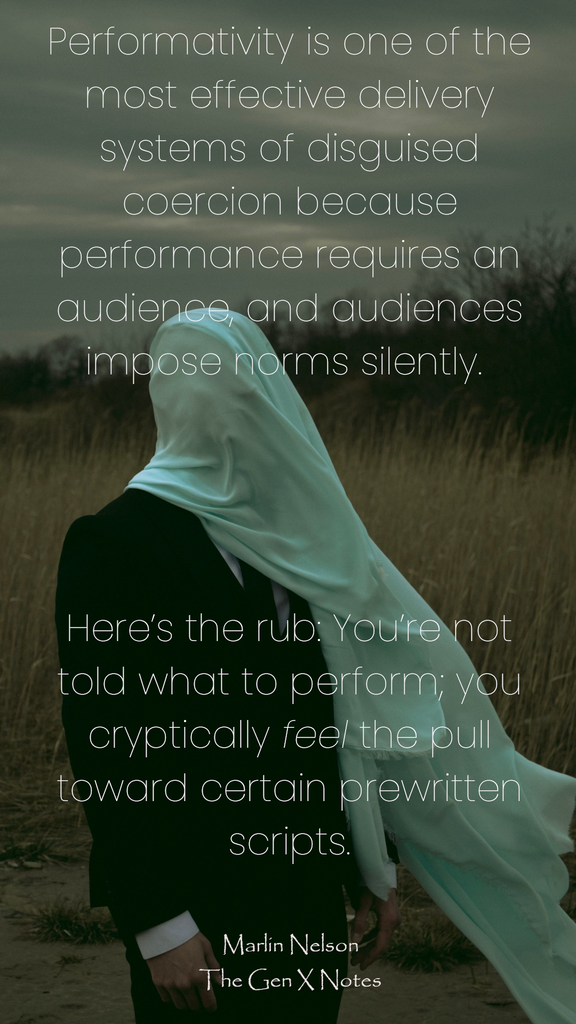
There was a time—beginning in the Industrial Age—when efficiency and output were metrics worth the gravitas they received. Unfortunately, today, the ideology of efficiency has become one of moral performance. It’s not that most people don’t want to be productive; it’s that to be seen as productive has replaced productivity itself as the goal. Actual production output has been captured by the desire to be seen. As such, we frequently see people online posting goofy videos of themselves at work, in uniform, performing instead of working. None of this is harder, smarter, or even more efficient; it’s mere theatre; pantomimists conveying whatever they deem worthy of being watched.
Back when “work smarter, not harder” became a slogan, it was supposed to be anti-hustle. Instead, along the way, it became hustle culture with better branding. A manager at a company that I once worked for would say it with reckless abandon, though he hardly ever worked and was known for cutting corners. Ironically, he decorated his office with “Grind,” “Hustle,” and “Execute” wall art. Go figure. To get back on topic, the “smarter” part of the statement is also performative; it signals sophistication, control, and intentionality. It’s another shiny, “look at me” apparatus. The “not harder” part is mere aspirational theater, because most people are working harder (typically). It might not be visible, but they’re putting in the work.
The Gen X Problem
Latchkey kids are caught in a specific tension. For one, you’ve likely outgrown the hustle script, though you may not have found a suitable replacement. Two, the “work smarter” narrative feels—and is—insufficient; it’s still framed around doing while ignoring be-ing. Three, midlife and performativity… Performativity at midlife, plain and simple, hits different. At this stage, it’s less about proving yourself and more about managing the appearance of having figured it out. This produces an exhaustion that early-career performativity didn’t. Why does it fail? The cobwebby “work smarter, not harder” narrative fails because it assumes there’s still a better way to perform the same game. At the intersection of mid-career, reinvention, or “starting from,” many players are different. You’ve likely witnessed innumerable substitutions: some moved on, others got promoted, and some paved new paths. But what if the game itself, not the players, is the problem? What if the Gen X flex is not to work smarter or harder, but to work better?
Working Better—Neither Smarter nor Harder
This is where it gets interesting as the waters get choppy. If we strip away both efficiency and performativity, what’s left? Working better. Right? Working better—in this context—might mean: Working truthfully, working selectively, working from rest, and working sans audience. Let’s navigate this:
- Working Truthfully: Forget optimizing for output or appearance; focus on alignment. Does this work feel like it matches who I actually am right now? Not the persona I projected at 28. Not who my LinkedIn profile suggests. Who I am in this moment.
- Working Selectively: Let’s be real… How many of us have worked in any way other than “smarter”? Forget working “smarter,” which implies a better, more discriminative method. Focus on choosing fewer things with more conviction. Think of it as intentional limitation; intentional limitation outweighs “smarter” every day.
- Working From Rest: The efficiency/performativity model assumes you’re trying to get somewhere or, perhaps, you have something to prove. Both lines of thinking imply desire, and every desire arises from deprivation, from lack. Working better might mean starting from the assumption that you’re already somewhere; you’ve already arrived. In this case, there is no scarcity; the work becomes an expression.
- Working Sans Audience: This one is choppy waters during a raging storm. Performativity requires a perceived or imaginary audience. Working better might mean doing work that cannot be performed. It’s work that’s too internal, too slow, too ambiguous to turn into a beacon for attention.
The Perspectival Shift
What if the real question isn’t “How do I work better?” but “Who am I trying to convince?” The performativity of efficiency is always directed at someone; always. At 25, it’s usually your peers, bosses, maybe even your future self. At 45, it’s probably directed at the ghosts of all of the above, plus a new audience: your own sense of whether you’ve “made it.” For the shift to occur, working better—not smarter nor harder—might mean putting the performance on ice. You no longer need to narrate for your future “glory days,” so let things take time without the narration. Always remember: Nature takes its time, but still gets everything done. Give up on needing an audience by working for fewer eyes, fewer judgments, and fewer metrics. Yes, I’m aware. Some metrics are necessary, but unless you’re an entertainer, do you really want to perform for a check? Lastly, embrace the final shift in perspective: Accept invisibility. Some of the best work you’ll do will never be tied to performability. That’s the feature, not the bug.
Conclusion
I’ll conclude here. To recap, we began by exploring the juxtaposition of performativity and efficiency, noting that one optimizes for output while the other is about visibility. We examined the shift in sloganeering and the “work smarter, not harder” narrative, and how its meaning has changed since its advent. We debunked hustle culture. After all, we’re more interested in better work: more meaningful, intentional, fulfilling, selective work.
We also examined the core problem for Gen Xers: Hustle, grind, and execution (as performance) have been laid to rest. Unfortunately, we struggle to find a suitable replacement—one that neither encourages nor rewards spectacle. Finally, we examined the perspectival shifts that may help guide us. Specifically, working at pace and without needing an audience.
We’ve broken the ice and begun paving a new path across treacherous terrain. Next, we will explore the disguised coercion angle to see how it tracks when performativity is the choice. A strong link between performativity and coerced choices that are worth tracking exists. Until then… Peace and clarity.